Overview of the Floating Electron System
Electrons floating in vacuum above liquid helium and solid neon
Our laboratory studies electrons floating in vacuum above the surfaces of liquid helium and solid neon, with the goals of uncovering fundamental physics and realizing quantum bits based on these systems.
How does a two dimensional electron system (2DES) form at the Vacuum–Liquid Helium/Solid Neon Interface?
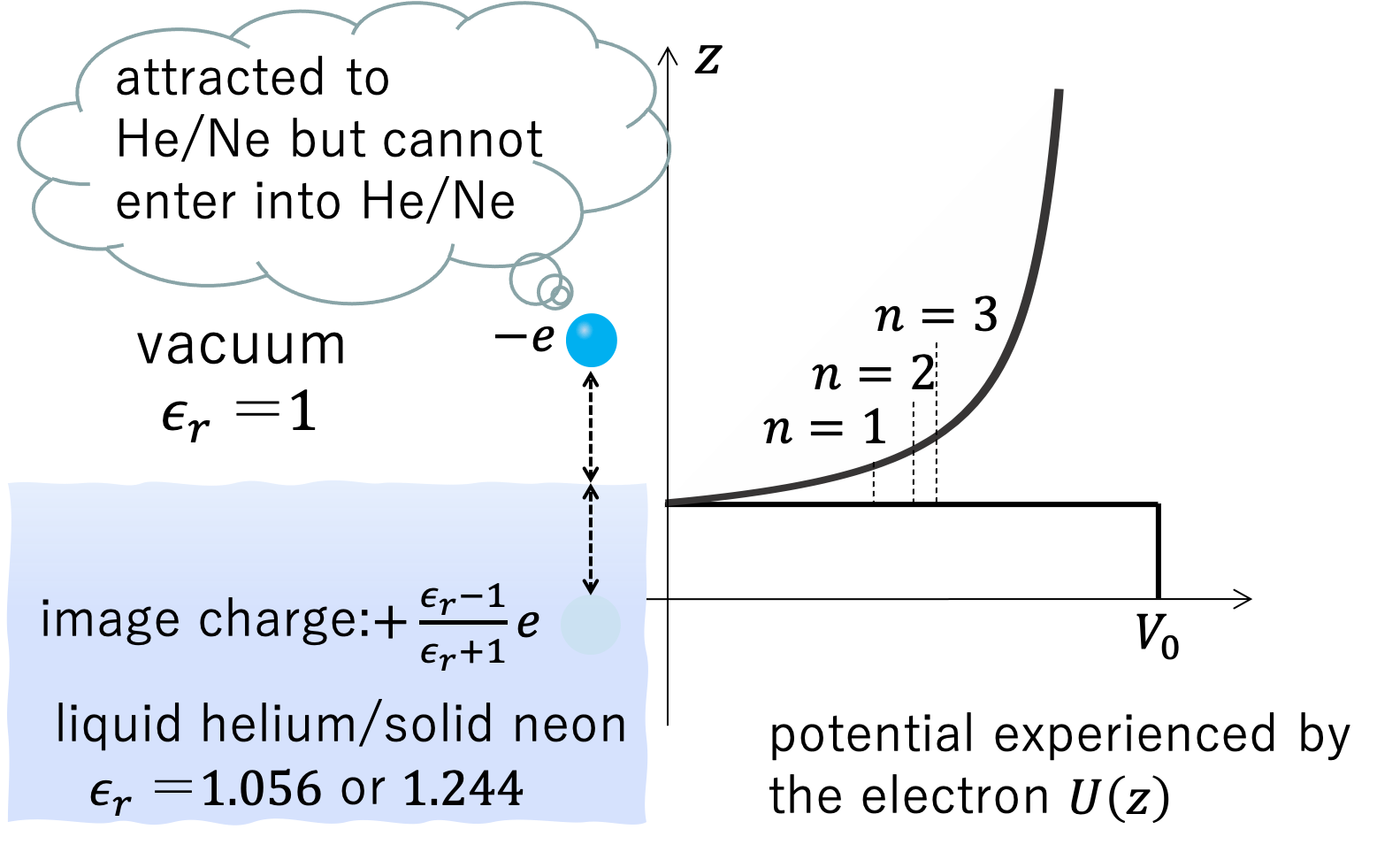
An electron floating in vacuum above liquid helium or solid neon is attracted by the image charge in the dielectric but cannot enter due to the surface barrier. The resulting potential U(z) confines the electron to discrete quantum states n = 1, 2, 3, …
When an electron in vacuum approaches a cryogenic substrate such as liquid helium or solid neon, it experiences an attractive force due to the substrate’s dielectric constant \(\epsilon_r\), which is slightly larger than that of vacuum. This gives rise to an effective positive charge of magnitude
\[+\frac{\epsilon_r - 1}{\epsilon_r + 1}e\]located inside the substrate at the same distance from the surface as the electron, a charge known as the image charge. Although the image charge attracts the electron toward the substrate, the negative electron affinity of these materials prevents the electron from entering. The resulting surface barrier is approximately 1 eV for liquid helium-4 and 0.7 eV for solid neon [1–3].
Combining the image-charge potential with this penetration barrier gives the total potential experienced by the electron as a function of its height \(z\) above the surface, as shown in the middle panel of the figure. The quantized probability densities for the ground state (\(n = 1\)) and first excited state (\(n = 2\)) in the \(z\)-direction are shown in the right panel. In liquid helium-4, the ground-state electron is localized on average approximately 10 nm above the surface. In solid neon, the larger dielectric constant leads to stronger confinement, bringing the average ground-state position to roughly 2 nm from the surface.
[1] E. Y. Andrei, Two-Dimensional Electron Systems: On Helium and Other Cryogenic Substrates (Springer Netherlands, 1997).
[2] Y. Monarkha, K. Kono, Two-Dimensional Coulomb Liquids and Solids (Springer, Berlin, Germany, 2004).
[3] M. W. Cole and M. H. Cohen, Phys. Rev. Lett. 23, 1238 (1969).
Liquid Helium vs. Solid Neon
Our laboratory investigates two distinct systems: electrons floating on the surface of liquid helium and electrons floating on the surface of solid neon. Below we describe the key physical differences that arise from these two cryogenic substrates.
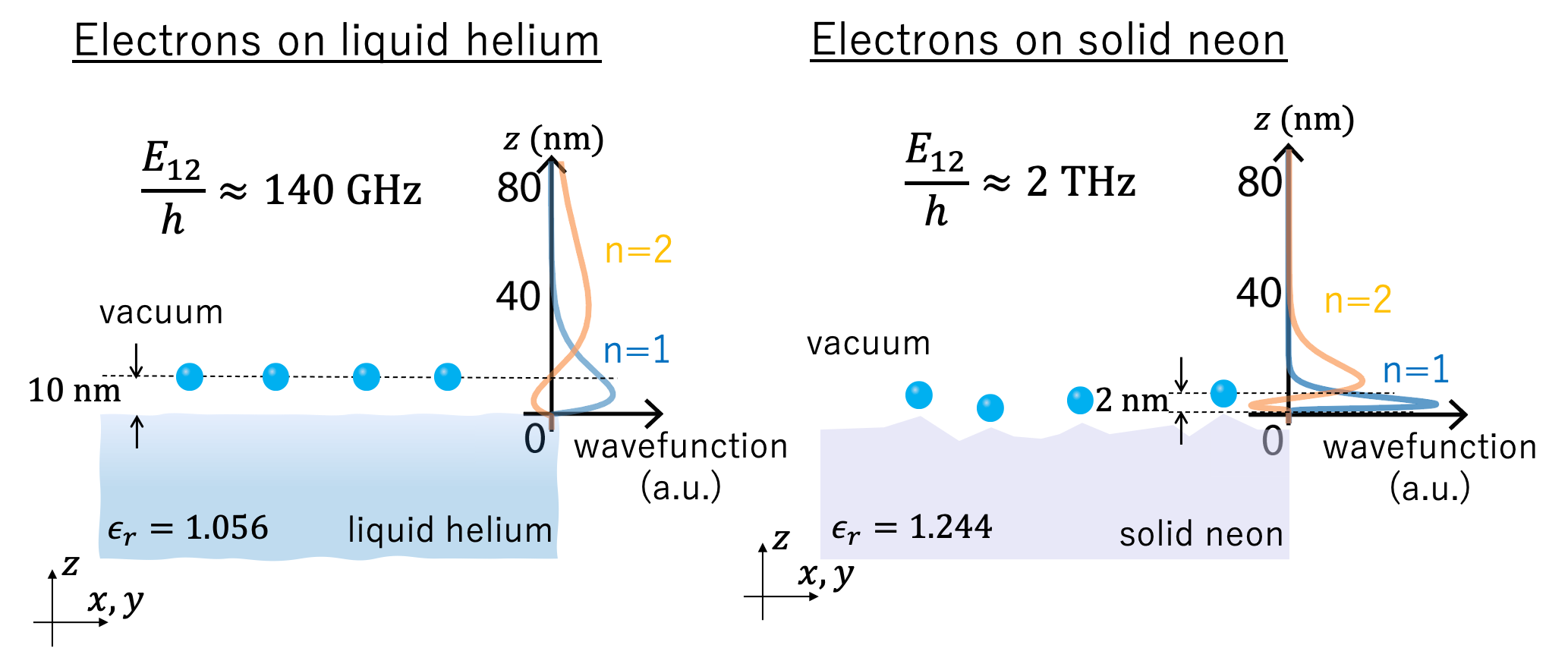
Comparison of electrons on liquid helium (left) and solid neon (right). The larger the relative permittivity, the stronger the attraction to the cryogenic substrate, resulting in tighter confinement and a larger energy spacing E12.
Electrons on liquid helium have been studied as a condensed-matter system for many decades. The surface of liquid helium is exceptionally uniform and clean, giving rise to electron mobilities far exceeding those found in conventional solid-state materials. It is also possible to trap a large number of electrons under nearly identical conditions in a spatially uniform manner. However, because helium is a liquid, its surface fluctuates in time — a fundamental limitation for quantum applications.
Solid neon, being a solid, does not suffer from such surface fluctuations. As a result, it has become clear in recent years that the quantum coherence of electrons is preserved for significantly longer times on solid neon. Although electrons on solid neon had received little research attention until recently, the first realization of a qubit using this system has attracted great interest over the past few years. One remaining challenge is that the solid surface tends to exhibit greater roughness compared with liquid helium.

Comparison of key properties of electrons on liquid helium and solid neon.
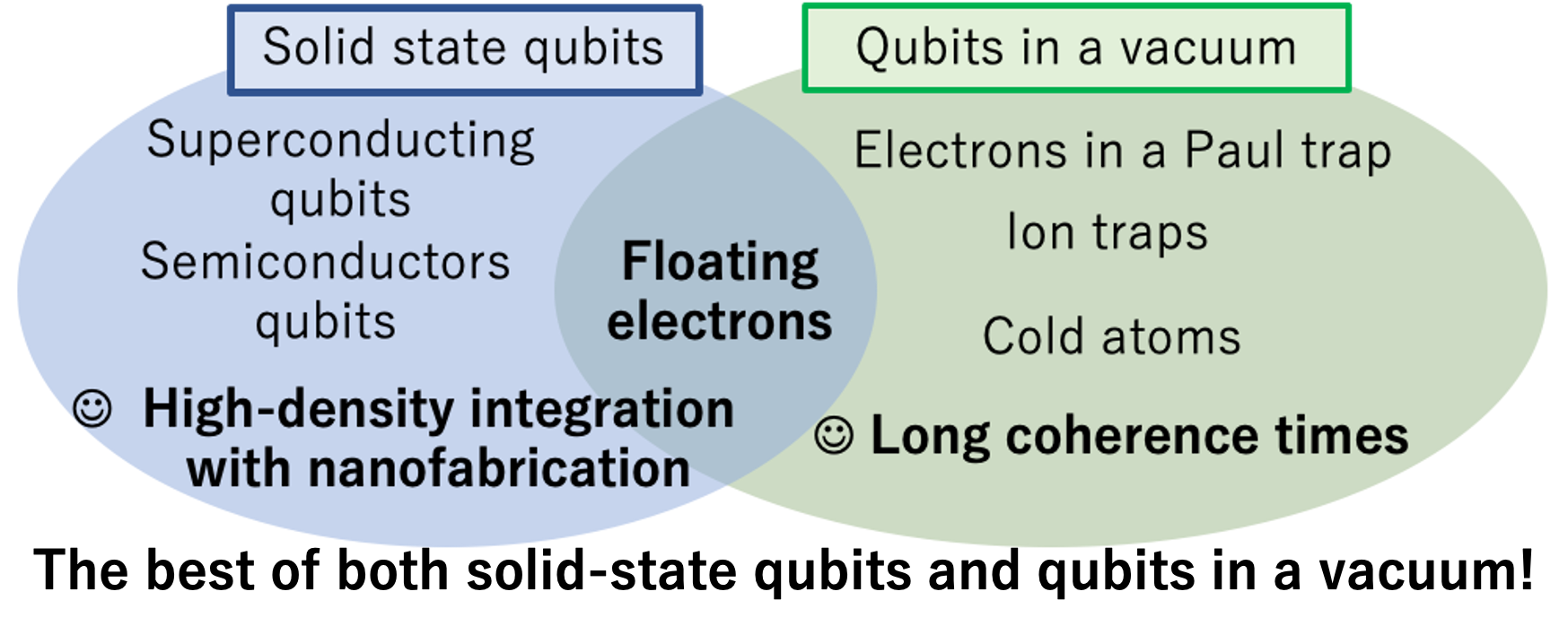
Floating electrons combine the advantages of solid-state qubits and qubits in a vacuum.
Charge qubits on solid neon:
[4] X. Zhou et al., Nature 605, 46 (2022).
[5] X. Zhou et al., Nat. Phys. 20, 116 (2024).
High electron mobility on liquid helium:
[6] K. Shirahama et al., J. Low Temp. Phys. 101, 439 (1995).
Low electron mobility on solid neon:
[7] K. Kajita, J. Phys. Soc. Jpn. 54, 4092 (1985).
Collective Excitations: Plasmons
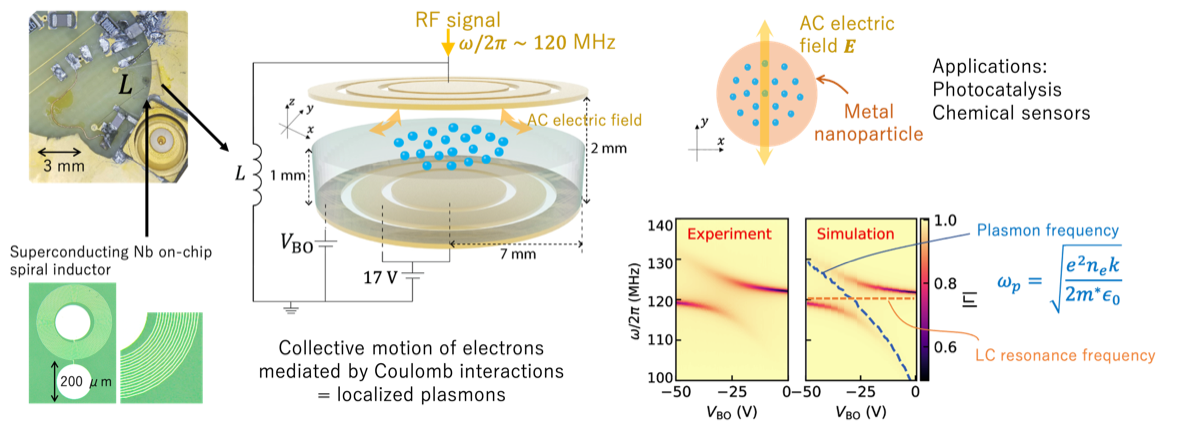
Plasmon excitations in a two-dimensional electron system measured via RF spectroscopy.